
In Memoriam
In the twenty-five years since I recorded the interviews on which this book is based, a number of contributors have passed on. I would like to begin by recalling them: Geoffrey Cornelius, Martin Davis, Dennis Elwell, Suitbert Ertel, David Hamblin, Warren Kenton, Lee Lehman, Maurice McCann, Peter Roberts, Noel Tyl, and Robert Zoller. It was a pleasure and privilege to talk with each of you.
Origins
In what follows I would like to share some reminiscences about this book’s origins, what happened after it was published, and what I have to offer by way of conclusions.
I started learning how to create and interpret horoscopes in 1976, and by the mid-80’s was contemplating becoming a full-time astrological consultant. Those plans were put on hold when I became a Buddhist monk from 1986 to 1993. That is another story; its main relevance to this account is the fact that I spent nearly seven years out of contact with astrology, and indeed the world in general. On returning, I found a major disjunction between the astrological scene I expected to find, and what actually existed.

Before going into the monastery I was in a local astrology group with David Hamblin, who was working on ‘harmonic astrology’ – an approach, pioneered by John Addey, that promised to set astrology on a more mathematical and therefore comprehensible footing. It seemed that this might dovetail with the statistical findings of Michel and Françoise Gauquelin – another source of hope for some vindication of astrology. In the monastery I heard little even of major world events, and nothing at all about the world of astrology. When I left the order in 1993 I discovered that – whilst I had been in seclusion – David Hamblin had lost his faith in astrology and given it up, and Michel Gauquelin had committed suicide. Both harmonic astrology and the Gauquelin work were getting little coverage in astrological journals. The certainties toward which astrologers seemed to be heading had evaporated. Astrological techniques from the medieval and earlier periods were gaining influence, represented and fostered by the emergence of Project Hindsight in 1992. I was faced by a proliferation of conflicting ideas about the best technical approach to astrology – no doubt heightened in my perception because it contrasted so much with the unanimity of praxis and purpose that prevailed in the monastery.
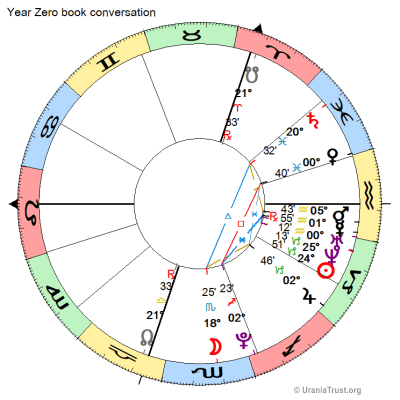
I started inching back into the world of astrology by attending a series of classes with the Faculty of Astrological Studies. These was taught by Christeen Skinner, an inspiring presenter who, I found, made astrology come vividly to life. One thing that struck me during the classes was that, for Christeen, astrology seemed a matter of both mind and heart; there was more to it than simply memorising and applying astrological techniques in an intellectually coherent way. Because I was still trying to figure out what astrology really was, I asked Christeen if I could interview her – sensing, I would say with the benefit of hindsight, that the personal story behind an astrologer’s approach might be a significant part of their work. During the interview Christeen suggested that I should consider putting together a book based on interviews with astrologers – Christeen, I owe you heartfelt thanks for that initiative, without which this book might never have existed. (By the way this happened at 6.50pm on 15th January 1996, in London.) I should also thank Jenni Dean Harte for introducing me to Frank Clifford one night in a Clapham pizzeria and suggesting to him that he should publish my book, which at that point amounted to no more than a handful of interviews and a lot of hope. It was one of the first books to come out in Frank’s imprint, Flare Publications. He is known to many astrologers now as the Principal of the London School of Astrology.
I was surprised by how open most of the respondents I approached were to my requests for interviews. I came to the enquiry with two linked aspirations: I hoped to find out how best to practise astrology; and, to pin down what kind of thing astrology actually was. Was it on the way to being established as a science, or was it something else? To give a little background on this question, I first learned of horoscopic astrology whilst reading The Occult by Colin Wilson in 1974, where Wilson argued that astrology was not an ‘exact science’, but was rather a type of ‘lunar knowledge’ similar to the I Ching and palmistry, with intuition a crucial part of the process.[1] Two years later, when I had started to study astrology, I was attracted to the works of Dane Rudhyar – particularly The Astrology of Personality, where I read that ‘astrology is not an empirical science’.[2] Although I therefore had a view of astrology as (somehow) not a science, at the same time I was influenced by the prevailing zeitgeist in UK astrology in the 80’s. This was that, somehow, the craft would turn out to cohere sufficiently with scientific principles and requirements that it could be tested and vindicated in those terms.
I hadn’t formulated it clearly at the outset, but as I recorded and pondered more interviews the dilemma between astrology as a science or something else started to come into focus. Two moments in particular stand out. One is the point when, during our 1997 interview, Robert Hand pointed out that the Hermetic maxim ‘as above so below’, often presented as a theoretical basis for astrology, is abridged from ‘as above, so below; as below, so above’. To my mind, this crystallised the possibility of an individual’s mind being an essential part of the astrological process with greater clarity than I had previously managed. The second moment was in 1998 in the Midheaven Bookshop on London’s Caledonian Road (sadly closed for some years now). During one of my regular visits I had a chat with John Etherington, the proprietor, and outlined the people I’d interviewed up to that point. I asked if there were any glaring omissions and he pointed me towards Geoffrey Cornelius’s book The Moment of Astrology and – thereby – the whole idea of astrology as divination. For some reason this was not an approach to which I’d previously paid attention. As I stood in John’s shop leafing through Moment, however, I was struck by how rigorously-argued it was, and how it dragged the obscure nature of astrological work out into the light of day. This appealed to what I’d like to think of as my philosophical side (my first degree was in philosophy) and it started to dawn on me that the idea of astrology as a form of divination might explain many of the subject’s mysteries. As I finalised Year Zero, therefore, my ideas about astrology were in flux.
Reception
Astrology in the Year Zero received generally favourable reviews from both astrologers and critics of astrology on its release in 2000. When the Sophia Centre programme for postgraduate study of astrology and cultural astronomy was established in 2002, copies were acquired for the university library and it was subsequently discussed in the course and in the work of postgraduate students. It was also referred to in a number of texts in the following years, including Roy Willis and Patrick Curry’s Astrology Science and Culture, Nick Campion’s Astrology and Popular Religion in the Modern West, and the second edition of Geoffrey Cornelius’s The Moment of Astrology.[3]
As for me – since Year Zero was published I have pursued my interest in astrology in a number of ways. These include becoming a part-time tutor and supervisor for the Sophia Centre’s MA and PhD students, writing and delivering occasional papers and talks, and completing my own PhD – entitled Astrology and Truth – in 2020. More about that later.
Criticisms
There were commentators on each side who had reservations about the final two chapters of the book. Some astrologers regretted that the discussion there did not culminate in an absolute vindication of astrology, whilst critics lamented what they saw as my failure to dismiss the idea of astrology as being true in any meaningful sense.
The approach I took was shaped by several factors. I felt a duty to my interviewees to present their views in as faithful a way as possible, and so did not want to demolish everything that had come before with some sort of ex cathedra pronouncement. Even had I wanted to do this, I was aware that my views were continuing to evolve, so did not feel placed to make any final judgements. Further, I wanted to leave readers room in which to reach their own conclusions. It seemed clear that any answers to questions about astrology’s validity would not be simple, and I was beginning to suspect that the most useful role the book could play would be to prompt readers to ask ‘better questions’, as I put it at the end of chapter 1. Hence the quotation from Italo Calvino that closed the final chapter was deliberately allusive and ambiguous, a suggestion that the world in which we live is in some way intertwined with our minds and that this might be relevant to astrology. This could be taken to mean that it was ‘all in the mind’, or that mind is intertwined with what we think of as the external world. This echoed the ‘two kinds of amazement’ with which I opened the first chapter and that seemed appropriately symmetrical.
In this Afterword I will allow myself a bit more leeway to lay out my views. As a route into this I will begin by considering the role of scientific evaluations and critiques of astrology.
The Question of Science
Some astrologers objected to Chapters 9 and 10 which contain an interview with five critics of astrology: Geoffrey Dean, the late Suitbert Ertel, Ivan W. Kelly, Arthur Mather and Rudolf Smit – collectively referred to in the text, for simplicity, as ‘the Researchers’. (Since Geoffrey Dean works with different groupings for different publications I will refer to ‘Dean et al.’ here, to point to the entirety of this work.) Some objections were bizarre, such as that of an astrologer who confided that Dean et al. were in the pay of an organisation, funded by the CIA, dedicated to dissuading the populace of astrology’s efficacy so as to make us all easier to control. He estimated that they would have been paid $400,000 for their contribution to the book. A more substantial objection came from the late Dennis Elwell, who introduced his case with a typically journalistic flourish: ‘It is as if we were invited to a convivial meal, only to find Hannibal Lecter among the guests’.[4] The basis of his objection was that Dean et al. were not impartial in their approach and that I should have challenged their arguments more robustly. This led to a discussion between Elwell and me, which we distilled into an article.[5] The short version is that we agreed, amicably, to disagree. I also suggested that Elwell should try out the approach that he believed would work in a discussion with Dean et al. This resulted in a series of exchanges that worked quite well in showing areas of disagreement, but not at all when it came to finding resolutions. I think it’s fair to say that it proved frustrating for all concerned.[6]
Now, as then, I contend that the decision to include Dean et al. was the right one. Astrology was being attacked in the media by people who had little knowledge of it. For instance, in a 1995 newspaper article Richard Dawkins (the incoming ‘Professor for Public Understanding of Science’ at Oxford University at the time) argued that ‘astrology is neither harmless nor fun, and... we should fight it seriously as an enemy of truth.’[7] This was a live issue as I was working on the book, and was mentioned by several interviewees.[8] In 1998 the professor of physics N. David Mermin, after ‘leafing through’ The Truth About Astrology by Michel Gauquelin could suggest in the pages of the journal Social Studies of Science that Gauquelin’s findings were ‘absolutely amazing’ but that – rather than meriting further research – this should raise the question, ‘could it be that the book is a work of fiction?’[9] It seemed that astrology was in danger of being swept away in a scientistic Year Zero by people who felt themselves entitled to dismiss it as a heretical view because it challenged scientific orthodoxy.[10] Given this context, it seemed a positive step to have a discussion with critics who had (in some cases) learned astrology and had the experience of it working (or seeming to work as they would subsequently decide) and who knew from experience that most astrologers were ‘intelligent and well-educated’ (p. 108). In other words they were prepared to take astrologers’ claims seriously and investigate the relevant research. I judged that it was better to engage seriously with critics who knew astrology than to let the entire subject be condemned out of hand by people who had not investigated the subject. I would still argue this case, though as will emerge presently I do not agree with all of the assumptions and conclusions of Dean et al. Indeed a central part of my thinking here is that if the critical position is laid out clearly, and if – as astrologers inevitably contend – it is flawed, then it should be possible to demonstrate where the problems lie. I will make my own attempt to articulate such an approach in what follows.
For anyone who is curious I should add that Geoffrey Dean and his colleagues have continued to produce work since Year Zero, in which you will find further discussion of what they see as shortcomings in tests and models of astrology, including mine. The best place to start for anyone who wishes to explore this is the website astrology-and-science.com. Two of the most recent and hefty works are Understanding Astrology and An In-Depth Philosophical Critique of Contemporary Western Astrology.[11]
The Utility, and Limitation, of Critical Scientific Perspectives
I do not want to minimise or obscure the objections raised against astrology in the name of science. I believe that these are well represented in chapters 9 and 10. In addition to the lack of compelling statistical data discussed by Dean et al., there are some fundamental conceptual issues for astrologers to consider. One is the fact that time twins are not identical iterations of the same person, another is the information overload of the ‘superchart’.[12] Such observations are, I contend, medicine for astrologers – as necessary as they may be bitter. There are questions for astrology here.
It seems to me that many astrologers are so convinced of astrology’s efficacy through their daily experience of it, that they assume any criticism must be misguided or ill-informed. The picture is more complicated than that, and I think that Dean et al. have made a valuable contribution to our understanding of astrology – up to a point. That point is the demonstration, through statistics and argument, that astrology does not function in the same, inexorable, way as (say) the law of gravity.
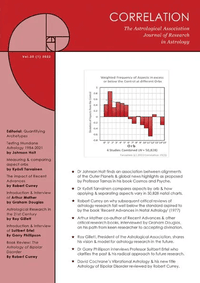
I should however add that research has yielded, and continues to yield, hints of statistically significant patterns in astrology. The Astrological Association’s research journal, Correlation, presents and discusses such findings. I think there may be a temptation for critics to ignore or steamroll such evidence in order to give the impression that all scientific evidence is univocally opposed to astrology. Indeed in 2008, looking back on his participation as one of the ‘Researchers’, Suitbert Ertel said that as the interview presented in chapters 9 and 10 proceeded he began to wonder if the group’s aim ‘was simply to remove any empirical indication of possibly unexplainable correlations between planets and human affairs.’[13]
This however does not mean that statistical findings show any promise of wholesale vindication of astrology. In chapter 11 (p. 152) I mentioned Michel Gauquelin’s argument that what could emerge from his research would not be astrology as we know it but a ‘neo-astrology’ so different as to be unrecognisable. In similar vein Mark McDonough, a researcher into astrology, designed a computer program that evaluated 300,000 astrological factors as possible parts of a signature for alcoholism. The results that came back did not fit with established astrological theory – McDonough reported that the data ‘was weird! It was not what you would expect, at all.’[14] He went to a major astrology conference, and found ‘there weren’t any satisfactory explanations. Nobody had an explanation for why the standard stuff [i.e. conventional astrological methodology] didn’t work.’[15]
There is, clearly, a disjunction between the largely meaningless results obtained when astrology is interrogated through statistical analysis, and the significance that astrologers believe emerges in individual readings. This poses a dilemma: are astrologers simply deluding themselves; or is there an alternative, more congenial, account of what astrology is and how it works? In what follows I will argue that such a case does exist, in the process revising and developing some thoughts I presented in the last two chapters of Year Zero. This will begin with an examination of what we assume astrology to be.
Astrology as an Information Service
The underlying assumption with which most critics approach astrology is that, if true, it would be an information service – something that delivers facts on demand with significant reliability. The underlying model is mechanical, as with a computer user accessing information stored in a database: information is demanded, and that information is delivered. Many astrologers find their subject to work sufficiently well that they assume that it does function along these lines – as may, I think, be glimpsed in Campion’s findings showing that with eight different cohorts of astrologers questioned between 1999 and 2011, proportions ranging from 24.5% to 87.5% would define astrology as a science.[16]
The mechanical model that underpins the idea of astrology as an information service presupposes that, for test purposes at least, certain factors such as the relationship between astrologer and client can and should be dispensed with in order that non-astrological factors (such as ‘cold reading’) are excluded. This approach was encapsulated in the remark of Dean et al. that ‘to adequately test astrology the participation of the astrologer must be eliminated.’[17]
I believe that this view finds a kind of apotheosis in the thought-experiment of ‘astrology world’ as set out by Dean et al.[18] In brief this is a world where astrology functions as a comprehensive information service, shaping every aspect of society from individual life-choices to the provision and scheduling of transport. The conclusion drawn by Dean et al. is that the failure of astrology to perform at anything approaching this level justifies the conclusion that astrology simply does not deliver. I want to suggest that this is an insightful criticism, for so long as it is assumed that a true astrology would necessarily be a science. But if that assumption is not made then what is criticised are the pretensions of science rather than astrology.
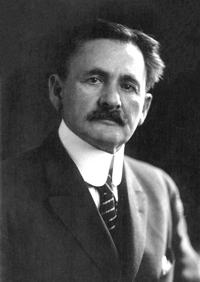
To illustrate: in 1894 the physicist Albert A. Michelsen argued for the pursuit of ever more precise ways to measure physical phenomena in order to facilitate ‘the steady onward march of science, by which alone truth is to be dug from its well and placed upon a foundation more solid and enduring than the pyramids.’[19] He further contended that ‘it seems probable that most of the grand underlying principles [of science] have now been firmly established and… further advances are to be sought chiefly in the rigorous application of those principles…’.[20]
Michelsen’s statement is sometimes cited as an example of scientific hubris, particularly given that within thirteen years Einstein would be working on the general theory of relativity.[21] It is a view according to which we know what is true only by deferring to physical science, a discipline – moreover – that is seen as virtually complete. Under such a view it follows that in order to be true, astrology would necessarily be part of science. ‘Astrology world’ is really ‘astrology-as-science’ world.
It seems sufficiently clear that astrology does not function in such an inexorable manner. The explanation of Dean et al. is that this is because astrology lacks purchase on the real world. I want to suggest an alternative position. You may have noticed that ‘astrology world’ bears quite a resemblance to dystopian accounts of humanity’s future such as Philip K. Dick’s The Minority Report, in which people with precognitive ability are used to pre-empt crime.[22] The upshot of The Minority Report is that the predictive model starts to break down because the actions of someone who knows what has been predicted is affected by the fact of their knowing the prediction. Patrick Curry remarked on a similar issue for astrology when he wrote that ‘every prediction is necessarily also an intervention… this truth precludes any fantasies of perfect and complete foreknowledge’.[23] I suggest that this opens the way to a different explanation of why the ‘astrology world’ model is absurd: it assumes a world of inert, unresponsive human subjects. The approach of Dean et al. does not only involve eliminating astrologers, it also involves eliminating the people to whose lives astrology might refer.
In order to characterise astrology as a practice which can be comprehended in its entirety by science, Dean et al. have insisted on a model which effectively precludes both astrologers and their clients. The question might arise, why anyone would choose to spend time testing and discussing the viability of something which they have already, convincingly, shown to be nonsense a priori – given their assumptions about how the world works.
Through their collation and analysis of tests of astrology, and discussion of thought-experiments such as ‘astrology world’, they have demonstrated the failure of astrology to perform as an information service under test conditions. Having reached this point, rather than seriously considering alternative perspectives, they have effectively insisted that this is the only model to which a true astrology would conform.
Falsification and Truth
I am aware that at this point I might be considered to be doing exactly what Dean et al. accuse astrologers of doing when their subject is challenged, namely retreating ‘behind a smokescreen of speculation about the nature of truth, reality, perception, language, and so on.’[24]
The question here must surely be, how are we to discriminate between speculative smokescreens and reasonable philosophical enquiry. Three of the group I interviewed (Dean, Mather and Smit) had been practising astrologers, with experience of the craft working well. They then found that astrology failed to perform in scientific tests. Whereupon they dismissed their own experience as illusory: astrology, they concluded, seemed to work but did not really.
Dean Mather and Smit decided that the negative data emerging from tests of astrology should overthrow their experience of astrology working in practice. Presumably they would regard the thought processes involved here as reasoned philosophical decisions and not their disappearance into a ‘smokescreen of speculation’.
This is a possible interpretation but not the only one. For example, McDonough had a different response to his research. Speaking of his massive research programme he said: ‘Do I think I disproved astrology? No. I have seen far too many amazing “coincidences” in astrology to believe that it doesn’t work.’[25] He chose not to consign his astrological experience to the dustbin of coincidence. This divergence in approach between McDonough and Dean et al. is interesting. There is a judgement call involved in deciding when statistics outweigh experience, and this will turn on one’s underlying, possibly unacknowledged, views about the world.
Hence Dean et al., discussing the possible relevance of ideas such as quantum theory to astrology, asked: ‘how can any kind of theory restore feasibility to something for which there is no convincing evidence to start with?’ (p. 136). There is a tacit assumption that the question of what would count as ‘convincing evidence’ has already been settled, and that any new theory would not change this. I find it interesting to juxtapose this with a remark from Mermin about ‘the truly spectacular degree to which compelling evidence in support of astrology would require a massive radical reconstruction of our current understanding of the world.’[26] Bringing these two arguments together we find that astrology would need a new paradigm to explain it; but new paradigms need not be considered because there is insufficient evidence within the old paradigm. The upshot is a catch-22 for discussions of astrology’s truth-status.
It is quite a popular argument amongst astrologers that developments in science will one day vindicate astrology. I have argued that there is a case that, insofar as they undermine the paradigm that renders astrology implausible, developments such as quantum physics weaken the case against astrology.[27] A handy example is a statement by the theoretical physicist Lee Smolin, that quantum physics ‘frees us from the fiction of the absolute observer, looking at everything from outside the world.’[28] As mentioned above, such an ‘absolute observer’ is just what is assumed for many tests of astrology.
Whether science will change so much as to allow astrology into its fold is a moot point; some astrologers are confident that this is underway, I am not so sure. In any case I think the stronger case is that astrology can be at least somewhat understood here and now if the idea of it being an unconditional information service operating in a mechanical universe is dropped, and the consequences of a conscious, responsive cosmos are introduced.
A Caveat About Categorising Astrology
Before moving on to consider this alternative conception of the cosmos, I would like to express a reservation about the binary choice that tends to insinuate itself into such discussions – and, indeed, can be seen in the title of Year Zero’s final chapter, ‘What is Astrology – Science or Magic?’. Looking back, I suspect that it may be a mistake to try and make astrology in its entirety fit into any single category of human understanding.

An ancient parable compared people with different views about the nature of the world to blind men each holding different parts of an elephant (the ear, the tusk, the trunk and so on), and believing that on this basis they could say exactly what an elephant was like.[29] Each person’s view about elephants was valid as far as it went, but at the same time far from complete. I suspect that ideas about astrology may be like this.
In our interview, Robert Zoller acknowledged having had a desire to reduce astrology to a reliable, mathematical, system. Yet, he concluded, although there are laws of the universe, ‘sometimes for seemingly inexplicable reasons those laws don’t work’. There is a ‘wild card’ that is a faculty of the human mind – or ‘maybe a faculty of the way being operates as a whole.’ (p. 151). If astrology is indeed ‘a faculty of the way being operates as a whole’ then it could be too diverse and wild for the human mind to constrain and comprehend. So as I turn to consider an alternative conception of the astrological cosmos I do so, not in the hope of pinning everything down once and for all, but of opening up a perspective more congenial to the understanding of astrology than that generally assumed by its critics.
A Responsive Cosmos
Nietzsche contended that ‘an essentially mechanical world would be an essentially meaningless world.’[30] This, I think, is another way in which the problem of the astrology as information service model can be seen. It also implies an essential feature of the alternative account of astrology that I will move on to consider now. This is more in tune with the account of astrology as meaning- and person-oriented that emerged (or perhaps it would be more accurate to say ‘re-emerged’) in the twentieth century through the thought of figures such as C. G. Jung and Dane Rudhyar.
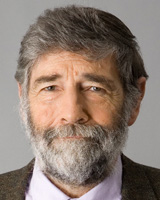
Geoffrey Cornelius has done much to develop this perspective on astrology’s nature, which he has dubbed ‘astrology as divination’. Commenting on a stipulation from Dean et al. that astrology must be tested by excluding the subjective participation of astrologers, Cornelius remarked that this ‘begs the question of the fundamental definition of astrology’ (Cornelius, 2003, p. 62). Further, he contended, ‘something about the participation of the astrologer… must have rung a warning bell for Geoffrey Dean, because it might lead him in a different direction to the preconceptions on which he has founded a lifetime of research’ (Cornelius, 2003, p. 62).
In chapter 12 (p. 167) I referred to David Bohm’s terms ‘mechanistic’ and ‘organismic’ to distinguish two views of the nature of the cosmos. Bohm characterised the former as intrinsically devoid of meaning, whilst under the latter - which he traced back to ancient Greek thought – each part is connected to other parts as well as to the whole in a living, meaningful cosmos. Given that much of astrology as we know it today developed under the same cosmology it is little surprise that the organismic account is more congenial for astrology.
The significant features of an organismic cosmos are that it is conscious, and responsive. The idea of a conscious cosmos has a long history as one possible explanation for astrology – as seen for instance in Aristotle: ‘We think of the stars as mere bodies, and as units with a serial order indeed but entirely inanimate; but we should rather conceive them as enjoying life and action.’[31]
The concept that we interact with a conscious, and responsive, cosmos was touched on in the final chapter of Year Zero. This comes to the surface particularly in the discussion of ‘as above so below, as below so above’ – which, as already remarked, struck me (and strikes me still) as deeply significant; and in William Lilly’s admonition to be ‘neer to God’ (p. 161; p. 164).
There has been considerable discussion amongst astrologers, in the last forty years, of the possibility and consequences of a responsive cosmos, often connected to the idea that astrology is a form of divination. Thus for example in 1984 Cornelius wrote of ‘the divine world intertwined with man, intimately responsive to his propitiation’.[32] This idea has been developed in several recent academic works on the nature of astrology, including those of James Brockbank, Lindsay Radermacher, and my own work.[33]

In Bernadette Brady’s recent PhD thesis she received 1,062 questionnaire responses from astrologers, (p. 186) and interviewed 21 astrologers (p. 249). In discussing the variegated nature of this group’s beliefs, based on all these responses, she concluded (p. 298) ‘there was a deeper theme that appeared to run through nearly all of the astrologers, and this was the notion of living a life in participation with a sympathetic cosmos.’[34] There is a long history of astrology being considered by astrologers to imply, and to depend on, a responsive relationship between human beings and the cosmos in which they live, which persists in contemporary astrological thought.
What Difference Does a Responsive Cosmos Make?
The view of astrology as a facet of a responsive cosmos means that every chart reading is unique and dependent on personal engagement. The model is not of a mechanical process that delivers information regardless of the states of mind of astrologer and client, but of an entreaty to a conscious and responsive cosmos (possibly conceived of as gods, or a God, as pantheistic or panpsychic – there are numerous options). One consequence of this is that the response is conditioned by such factors as the sincerity and humility of the astrologer and their client. Further, what is conveyed in a reading may be directly relevant to one’s ostensible purpose in consulting a chart, but may address a different matter. Cornelius characterised this as ‘the unique case in astrology and divination’.[35] It is an approach is discussed at pp. 164–66 of Year Zero, where I referred to Jung’s experience with the I Ching and the need to approach divination as if dealing with a respected teacher.
This is the opposite of the requirements for replicability and objective evaluation that come with the view of astrology as science, and thus undermines claims on behalf of scientific/statistical methodology to be able to evaluate what astrologers do. I should return to the parable mentioned earlier and acknowledge that scientific methodology may offer an alternative way to get hold of part of the elephant of astrology. If, however, we take it that astrology addresses meaning in human lives, it was always implausible in terms of first principles that a mechanical – and therefore inherently meaningless – model could be capable of getting to the heart of astrology.
Philosophy Rears its Ugly Head
When I was putting Year Zero together I started to feel that there was an underlying philosophical issue in the way we think about astrology, and that some of astrology’s critics might be unconsciously succumbing to confirmation bias – precluding arguments that would undermine their position. My pursuit of this possibility eventuated in my PhD thesis, completed in 2020, with the connection to Year Zero flagged on page one: The enquiry presented here has grown out of my book Astrology in the Year Zero, in particular my contention that any evaluation of astrology ‘will be based on one’s view of issues such as: what is real; how we acquire knowledge; and how our knowledge relates to reality. In other words, philosophical issues which are as old as philosophy itself.’ (p. 1; p. 169)
In the thesis I took western philosophy’s theories of how truth can be defined, and applied them to the case of astrology. The guiding principle was to use philosophy as – so to speak – an impartial arbiter. Three major theories of truth have emerged through the history of western philosophy, and to the best of my ability I evaluated the ways in which these have been and could be applied to astrology. For instance, I was able to show that Richard Dawkins appealed at different points in his work to each of the theories, but only in ways that buttressed his position. By deploying comprehensive definitions and applications of the theories to the discussion of astrology I was able to show how doubts about astrology’s truth-status arise; that, despite a widespread assumption to the contrary in the western world, there is a case for considering astrology to be true; and, that the question ultimately turns on the kind of cosmos in which we believe ourselves to be living. If we think that this is a mechanical universe, the relevant evidence is of the kind to which critics generally refer – that, even if it may offer glimpses of some sort of neo-astrology, does not support horoscopic astrology as we know it. A conscious, responsive, cosmos on the other hand would make astrology more plausible. Although advocates of science such as Dawkins sometimes assert that the cosmos is meaningless and dead, this is outside the competence of science to rule on and therefore such opinions carry no special weight.
Summing Up
There are arguments for humanity being more closely implicated in the cosmos than has been thought whilst materialism has held sway in western thought. These have been eloquently made, for example, by the philosopher Mary Midgley. After acknowledging that the last three centuries have seen great advances following from scientists’ assumption that ‘they should treat everything they studied only as a passive, insentient object’, she concluded that ‘in many areas, the advantages of ignoring ourselves have run out.’[36]
An acknowledgement of our involvement, as conscious individuals, in the cosmos – even if it is a responsive cosmos – opens up a vista for enquiry but does not prove that astrology is true. This however may be no bad thing. Astrology might need to be mysterious – a wildcard and oddball – in order to be a useful adjunct to life. We may need to grapple with the information it provides, to question if and how it applies, if it is to be a blessing rather than a curse.
I would not argue that everyone should believe in astrology, nor even investigate it. Clearly many live fulfilling lives without thinking twice about it. But if the subject has piqued your interest, my suggestion is to investigate it on your own terms. Nobody can tell you, from an authoritative and objective position, what to think about astrology. In the end the only way to find out if it speaks to you is to get experience by having your chart read or perhaps learning some basic astrology and trying it out. It could also help to enquire into the experiences of astrologers, their clients and their critics – perhaps by reading a book such as this one.
†Phillipson, G. (2025). Astrology in the year zero. Sophia Centre Press. (Original work published 2000)
An early interest in spirituality, astrology, and other forms of divination combined with Garry's first degree in Philosophy resulted in a lifelong enquiry into the human condition, with particular reference to those liminal areas where the human and more-than-human intersect, or appear to. He has studied with and lectured for Bath Spa University, University of Kent at Cangerbury, and the Sophia Centre at University of Wales.Garry Phillipson
References
[1] Colin Wilson, The Occult (London: Hodder & Stoughton, 1971), p. 325.
[2] Dane Rudhyar, The Astrology of Personality: A Re-formulation of Astrological Concepts and Ideals, in Terms of Contemporary Psychology and Philosophy (3rd edn.) (Garden City, NY: Doubleday 1970 [1936]), p. 40.
[3] Roy Willis and Patrick Curry, Astrology, Science and Culture: Pulling Down the Moon (Oxford: Berg, 2004); Nicholas Campion, Astrology and Popular Religion in the Modern West: Prophecy, Cosmology and the New Age Movement (Farnham: Ashgate, 2012); Geoffrey Cornelius, The Moment of Astrology: Origins in Divination (2nd edn.), (Bournemouth: Wessex Astrologer, 2003).
[4] Dennis Elwell in: Garry Phillipson and Dennis Elwell, ‘Self-Defence for Astrologers’, The Astrological Journal Vol. 43 No. 5 (Sept/Oct 2001), p. 14. Full article is pp. 13–22.
[5] Phillipson & Elwell (2001).
[6] Collected as ‘Dialogue between Dennis Elwell and the Researchers’ at www.astrozero.co.uk/science
[7] Richard Dawkins, ‘The Real Romance in the Stars’, Independent on Sunday, 31 December 1995, p. 18. The article was substantially repeated in chapter 6 of Dawkins’ Unweaving the Rainbow: Science, Delusion and the Appetite for Wonder (London: Allen Lane, 1998).
[8] Those that are included in the book are: Nick Campion at pp. 32–33, and a more general reference to Dawkins from Graeme Tobyn at p. 76.
[9] N. David Mermin, ‘The Science of Science: A Physicist Reads Barnes, Bloor and Henry’, Social Studies of Science (Vol. 28, No.4, Aug 1998), p. 622.
[10] I subsequently developed the idea of astrology being seen as a heresy against science, much as it had been seen as heresy against the Church, in a paper: Garry Phillipson, ‘Astrology as Heresy in Contemporary Belief’ Journal for the Study of Religion, Nature and Culture Vol. 13, No. 1 (2019), pp. 12–30.
[11] Geoffrey Dean, Arthur Mather, David Nias and Rudolf Smit: Understanding Astrology: A Critical Review of a Thousand Empirical Studies 1900–2000 (Amsterdam: AinO Publications, 2022) www.
astrology-and-science.com/U-aino1.htm (checked 8th August 2024); Ivan W. Kelly and Don H. Saklofske, ‘An In-Depth Philosophical Critique of Contemporary Western Astrology’ (Online article, 2024: previous versions 2021, 2022, 2023) www.astrology-and-science.com/U-idpc1.htm
[12] Introduced in the interview with Dean et al. at pp. 127–28, with further discussion in Appendix 2 of this book. The ‘superchart’ is presented at p. 138.
[13] Particularly with reference to the treatment of the Gauquelin data. Suitbert Ertel, Garry Phillipson: ‘Interview with Suitbert Ertel’, Correlation – The Astrological Association Journal of Research in Astrology, Vol. 35 No. 1 (2022): pp. 60.
[14] Mark McDonough, ‘An Interview with Mark McDonough conducted by Garry Phillipson’, Correlation 24.1 (2006): pp. 34–40, quotation from p. 36.
[15] McDonough, p. 36.
[16] Campion, Astrology and Popular Religion, p. 178.
[17] Geoffrey Dean, assisted by Arthur Mather and 52 collaborators, Recent Advances in Natal Astrology: A Critical Review, 1900 – 1976 (Subiaco, Western Australia: Analogic, 1977), p. 554.
[18] ‘Astrology world’ is introduced at p. 129; I commented on it at p. 168 and subsequently revisited the issue in: ‘Understanding Astrology: A Question of Belief’, Correlation Vol. 36, No. 1 (2023): pp. 75–79. The idea of ‘astrology world’ can be traced back to: F. K. Donnelly, ‘The Perfect World of Astrology’, Humanist in Canada Vol. 69, No. 17 (Summer 1984): pp. 20–22.
[19] Albert A. Michelsen, ‘Some of the Objects and Methods of Physical Science’ (an address to the Seventh University of Chicago Convocation, July 2, 1894), University of Chicago Quarterly Calendar Vol. 3, No. 2 (1894): p. 15.
[20] Michelsen, p. 15.
[21] For discussion and further examples: Marco Giliberti & Luisa Lovisetti, Old Quantum Theory and Early Quantum Mechanics (Cham, Switzerland: Springer, 2024) pp. xv–xvii; Alan A. Grometstein, The Roots of Things: Topics in Quantum Mechanics (New York: Springer, 1999), pp. 146–47.
[22] Philip K. Dick, ‘The Minority Report’, Fantastic Universe Vol. 4 No. 6 (1956): pp. 4–36.
[23] Patrick Curry in: Willis and Curry, Astrology, Science and Culture, p. 55.
[24] Year Zero, p. 129.
[25] Mark McDonough, ‘An Interview with Mark McDonough conducted by Garry Phillipson’, Correlation 24(1), 2006, pp. 34–40, quotation from p. 36.
[26] Mermin, ‘Abandoning Preconceptions’, p. 642.
[27] This possibility was posed as a question to Dean et al. (p. 136), and developed in: Garry Phillipson, ‘Modern Science, Epistemology and Astrology’, Correlation Vol. 23, No. 2 (2006), pp. 4–23; Garry Phillipson, Astrology and Truth: A Context in Contemporary Epistemology (University of Wales Trinity Saint David, 2020) particularly pp. 189–202. Thesis available at Cosmocritic.com.
[28] Lee Smolin, The Life of the Cosmos (London: Weidenfeld & Nicholson, 1997), p. 243.
[29] The earliest version I know is in The Udāna which dates the parable to somewhere between the 5th and 3rd centuries bce. Peter Masefield (tr.), The Udāna (Oxford: Pali Text Society, 1994) pp. 128–33 (Chapter 6:4). I previously used the elephant simile in an article, ‘Astrology and the Anatomy of Doubt’ in The Mountain Astrologer Aug/Sept 2002.
[30] Friedrich Nietzsche, W. Kaufmann (tr.), The Gay Science (New York: Random House, 1974) p. 335.
[31] Aristotle, De Caelo, Book II.12: 292a 18-21. This translation: D. J. Allan, rev. J. L. Stocks in Jonathan Barnes (ed.), The Complete Works of Aristotle: The Revised Oxford Translation (One Volume Digital Edition), (Princeton, NJ: Princeton University Press/Bollingen, 1984), p. 1056.
[32] Geoffrey Cornelius, ‘The Moment of Astrology Part IV’, Astrology: The Astrologers’ Quarterly Vol. 58, No. 2 (Summer 1984), p. 88.
[33] James Brockbank, The Responsive Cosmos: An Enquiry into the Theoretical Foundation of Astrology (doctoral thesis, University of Kent, 2011). Lindsay Radermacher, The Role of Dialogue in Astrological Divination (MPhil dissertation, University of Kent, 2011). Garry Phillipson: Astrology and Truth (PhD thesis); ‘Panpsychism and Astrology’ in Frances Clynes (ed.), Skylights: Essays in the History and Contemporary Culture of Astrology (Ceredigion: Sophia Centre Press, 2022), pp. 165–86; ‘Astrology, Modernity, and the Disputed Nature of Self’ in William Burns (ed.), Astrology and Western Society from the First World War to Covid-19 (Cham: Palgrave Macmillan/Springer, 2023) pp. 31–71. The theses and MPhil are available from Cosmocritic.com.
[34] Bernadette Brady, Theories of Fate Among Present-day Astrologers (PhD thesis, University of Wales Trinity St. David, 2012) p. 298. [Forthcoming from Sophia Centre Press] In her thesis Brady discusses various perspectives on the Stoic concept of sympatheia – these overlap sufficiently with the idea of a responsive cosmos as to be synonymous for the purpose of this discussion.
[35] Cornelius, Geoffrey, ‘From Primitive Mentality to Haecceity: The Unique Case in Astrology and Divination’ in Patrick Curry and Angela Voss (eds.), Seeing with Different Eyes: Essays in Astrology and Divination (Newcastle: Cambridge Scholars Publishing, 2007) pp. 228–29 and passim.
[36] Mary Midgley, Science and Poetry (London: Routledge, 2001) p. 84.