
The Integrity of the Vedic Designation
Jyotiṣa as Vedic Astrology
द्वादश प्राधायश चक्र एकम् त्रिनि नभ्यानि क उ तच चिकेता / तस्मिं सकं त्रिशत न शङ्कवो 'र्पिताः षष्टिर न कालचलसः
dvādaśa pradhayaś cakram ekaṃ trīṇi nabhyāni ka u tac ciketa / tasmin sākaṃ triśatā na śaṅkavo 'rpitāḥ ṣaṣṭir na calācalāsaḥ
"Twelve are its fellies, the wheel is one, it has three naves — who has understood it? In it are held together like spokes the 360, both moving and non-moving."
—Ṛgveda 1.164.48
ABSTRACT
Every tradition crossing a linguistic boundary faces a choice between translation and designation. Jyotiṣa translated is the science of light — accurate, beautiful, and practically useless in the market place. Designated correctly, it is Vedic astrology: the address that locates the tradition within the civilizational corpus it actually inhabits. Two challenges currently contest that designation — Western scholarship's claim that the tradition's methods were borrowed from ancient Greece, and the legitimate concern that Hindu nationalism has weaponized the Vedic label as an instrument of exclusion. Both challenges rest on the same colonial error: the construction of Vedic culture as narrow, derivative, and the exclusive property of a specific group.
This paper dismantles that construction on two grounds. Historically, the tradition generated its own celestial science from indigenous astronomical observation predating any outside contact; the scholarship claiming otherwise has been exposed as methodologically compromised. Ethically, the designation belongs to every practitioner who works honestly within it — Muslim astrologers, Dalit lineages, Tamil practitioners, Western students — not as a gesture of inclusion but as a description of how the tradition has always actually worked.
Hindu astrology designates a census population. Indian astrology designates a colonial map. Vedic astrology designates the tradition from inside the tradition. Jyotiṣa named itself the Eye of the Veda long before anyone had reason to contest that name.
I. "India" Is Not a Neutral Word
"Indian astrology" sounds like the responsible scholarly choice — neutral, geographically grounded, free of religious freight. It is none of those things. India is not a neutral term. It is a four-stage colonial transformation of a Sanskrit river name.[1]
The first stage is Persian: Old Persian gives Hindu as the cognate of Sanskrit Sindhu, the great river. The second is Greek: Alexander's geographers received the Persian Hindu, dropped the initial h, and coined Indos for the river and India for the land beyond it. The third is Latin: Roman scholars carried Indos and India into the administrative vocabulary of empire. The fourth is British: the Government of India Act, the Indian Civil Service, the Indian Penal Code — each instrument embedding the Greek geographical label into the apparatus through which the subcontinent was governed, taxed, and ultimately partitioned. "India" became not merely a name but a legal reality imposed on a civilization that had never used the term for itself.
Scholars who invoke "Indian astrology" as a term of precision are therefore wielding a four-stage colonial transformation of a Sanskrit river name filtered through Persian conquest, Greek geographical imagination, Roman administrative Latin, and British colonial law. Their supposedly neutral geographic designator carries more layers of external imposition than the term it presumes to correct. The preference for "Indian" over "Vedic" recapitulates, at the level of nomenclature, precisely the colonial operation it presents itself as opposing. Many Indian scholars now prefer Sindhu-Sarasvatī civilization over "Indus Valley civilization" for analogous reasons — restoring indigenous river names to indigenous cultural designation.
No ancient text refers to the tradition by a geographical name.[2] The tradition named itself Jyotiṣa — the science of light — and designated itself the Eye of the Veda: a description of cosmological function, not geographical address. Applying a geographical name to Jyotiṣa is an epistemological category error. "Indian astrology" plants a geographical flag on a tradition that understands itself as transmitting sacred revelation — cosmic knowledge heard by the seers — not a cultural product. The name does to Jyotiṣa what colonial governance did to the subcontinent: it replaces a living self-understanding with an administrative label.[3]
II. Every Culture Watched the Sky
Before Greece had a zodiac, the Ṛgveda encoded one. RV 1.164.48 — "twelve are its fellies, the wheel is one, it has three naves; in it are held together like spokes the 360" — encodes the structural geometry of a twelve-part solar zodiac within the Ṛgveda itself.[4] Critics of the Vedic designation often press the apparent discontinuity between the nakṣatra-based Ṛgveda and the twelve-sign system of later horoscopic Jyotiṣa, implying that the zodiacal apparatus must have arrived from Greece. The verse answers that charge directly. The twelve fellies are twelve solar divisions of the annual wheel; the 360 spokes are the degrees of the solar year; the single wheel is the annual solar circuit. The twelve-sign system is not a Greek import overlaid upon an otherwise non-zodiacal tradition. It is the maturation of a geometry already present in the Ṛgveda's oldest hymns — a refinement of indigenous Vedic solar reckoning rather than a foreign transplant. The transmission paradigm requires a rupture between Ṛgvedic and horoscopic Jyotiṣa that the text itself refuses to supply.
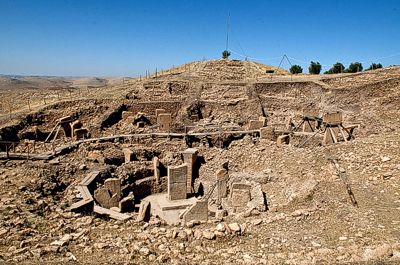
The transmission paradigm depends on an unstated premise: that sophisticated celestial science arose in one or at most two centers of civilization and radiated outward to less developed peripheries. The global archaeological record renders it untenable. Newgrange in Ireland, dated to approximately 3200 BCE, is oriented to admit the winter solstice sunrise through a purpose-built roof-box. Stonehenge encodes solar and lunar alignments across multiple construction phases — predating any plausible Mesopotamian or Hellenistic transmission by millennia. Göbekli Tepe in Anatolia, dated to approximately 9600 BCE and predating pottery, agriculture, and every other known site of organized monumental construction, shows strong evidence of stellar alignments implying systematic astronomical orientation eleven millennia before any putative Hellenistic transmission.[5]
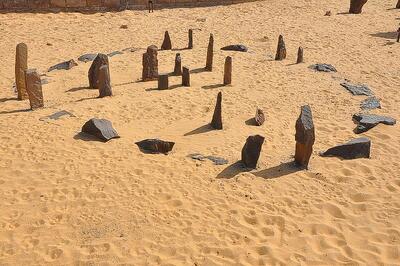
The oldest known monumental architecture on earth is celestially oriented — and the pattern holds across every continent. Nabta Playa in sub-Saharan Africa, dated to approximately 4500 BCE, predates Stonehenge and encodes alignments to Sirius and the summer solstice, built by communities with no conceivable connection to Mesopotamia or the Levant.[6] The Caracol observatory at Chichen Itza tracks Venus cycles with extraordinary precision from the other side of the world. These traditions share no transmission network. They share a night sky. The transmission theorist must now explain why Jyotiṣa alone, among the celestial traditions of every Neolithic and Bronze Age culture on earth, supposedly lacked indigenous foundations and required Hellenistic instruction.
Newgrange tracks the winter solstice sunrise — a tropical alignment. Stonehenge encodes the 18.6-year lunar nodal cycle — a calendrical one. The same monument culture held both orientations as necessary, neither canceling the other. Jyotiṣa's retention of the sidereal zodiac is not a failure to correct a precession error. It is a deliberate philosophical commitment to orienting the soul's journey against the fixed stellar background rather than the shifting seasonal frame.

Kṛttikā is a nakṣatra — one of the 27 lunar mansions through which the Moon moves in its monthly arc across the fixed stellar background. The Śatapatha Brāhmaṇa records the Kṛttikās as never deviating from the east, an astronomical statement placing that nakṣatra at the vernal equinox and anchoring Ṛgvedic composition in the third millennium BCE.[7] That placement is itself a precessional calculation. A tradition that could perform that calculation knew exactly what it was choosing to retain — and retained it by design.
III. The Scholarship Was Compromised
The academic case for "Indian astrology" rests on a foundation that has since been shown to be compromised. Late nineteenth-century German scholarship produced Panbabylonism: Mesopotamia as the singular source of all celestial science, every other civilization a recipient. Panhellenism narrowed and sharpened that claim — Greece replaced Babylon as the origin point, and David Pingree gave it its definitive scholarly form. Both frameworks share a single assumption: that Asian cultures received celestial science rather than generated it. Both served the same end: maintaining Western intellectual priority by denying indigenous achievement to non-European civilizations.
The keystone of Pingree's transmission narrative was his 1978 edition of the Yavanajātaka of Sphujidhvaja. Bill Mak's discovery of a previously unknown Nepalese manuscript exposed its foundations: Pingree had interpolated passages, misrepresented manuscript variants, and constructed a transmission history the surviving evidence cannot support.[8] An independent analysis by Shukla had already identified computational errors and textual misreadings throughout the same edition.[9] The scholarly edifice on which the academic preference for "Indian astrology" rests is, at its foundation, compromised.
The positive case is equally direct. Roger Billard's mathematical analysis compared the planetary positions recorded in Indian astronomical treatises against modern calculations and found that Āryabhaṭa's figures match what an observer in India around 510 CE would actually have seen in the sky — not what a copyist working from old Greek tables would have produced.[10] Indian astronomers were watching the sky and refining their own models from direct observation. That independence demolishes the claim that Indian astronomy was a provincial echo of Hellenistic achievement.
The double standard becomes clear when applied consistently. Western scholars do not rename "Greek philosophy" as "Mediterranean philosophy" on the grounds that pre-Socratic thought drew upon Egyptian and Babylonian sources — and those debts are well documented. A structural parallel is visible in Classical Chinese Medicine, where "East Asian Medicine" has gained institutional traction by absorbing Korean and Japanese traditions alongside the Chinese classical corpus. Korean Hanbang and Japanese Kampō are genuine lineage traditions in their own right — both developed in direct relationship to the Chinese classical foundation, just as regional Indian lineages are downstream expressions of the Vedic-Purāṇic corpus. The broader umbrella term erases the source even when adopted with good intentions. "Vedic" faces heightened critical scrutiny as a religious designation while "Greek" remains an unquestioned civilizational category — a persistent asymmetry rooted in one assumption: that Western traditions possess self-evident civilizational identities authorizing their self-designations, while Asian traditions require external reorganization before their names may stand. The asymmetry is not methodological. It is political. The correction begins with the name itself.
Vedic is not primarily a religious designation in the sense Western scholars intend when they apply that critical scrutiny. It is a civilizational and textual designation, analogous to Hellenic or Confucian — identifying a tradition by its foundational corpus and the cosmological framework that corpus transmits.
IV. The Eye of the Veda
Jyotiṣa is not one of the Vedic disciplines. It is the one that makes all the others navigable in time. The designation of Jyotiṣa as the Eye of the Veda is not an honorific appended after the fact. It is a structural description of how celestial knowledge functions within the living Vedic system. Jyotiṣa is one of the six Vedāṅgas — the limbs of the Veda — each assigned a specific bodily function: phonetics is the nose, the organ of breath that carries sacred sound; grammar is the mouth, the organ of precise articulation; etymology is the ear, the organ of deep hearing and interpretation; metre is the feet, the rhythmic foundation upon which the hymns move; ritual procedure is the hands, the instruments of enactment. These are not decorative metaphors. The bodily designations describe functional relationships — what each discipline does within the living corpus. Eyes do not decorate a body. They guide it. Jyotiṣa is the instrument through which Vedic civilization orients itself in time.
The embeddedness extends far beyond ritual timing. Jyotiṣa permeates the Purāṇic literature through which Vedic cosmological knowledge became accessible across the full range of practitioners. The Śrīmad Bhāgavatam contains extensive cosmological and astronomical material, situating planetary motion within the framework of cosmic time that governs all existence. The Bhagavad Gītā's philosophical architecture — the interplay of time, karma, and dharma — is unintelligible without the temporal cosmology that Jyotiṣa both maps and navigates. The Viṣṇu Purāṇa and Mārkaṇḍeya Purāṇa integrate planetary cosmology into their theophanic narratives, presenting the planets not as astronomical objects but as cosmic intelligences operating within the soteriological architecture of the universe.
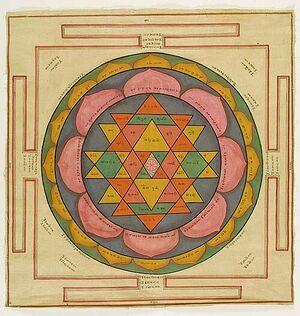
The Vedic time lord system has no parallel in any Hellenistic, Babylonian, or Chinese tradition. It is a 120-year planetary period cycle distributed among the nine planets according to the nakṣatras each governs, its mathematical structure inseparable from the nakṣatra system's 27-fold lunar division. A nakṣatra governs each planetary period; the full cycle maps the soul's journey through incarnation across an ideal human lifetime. No other tradition produced anything like it. Hellenistic and Perso-Arabic time lord systems — Decennials, the chronokratores, Firdaria — are sometimes cited as parallels, but the structural differences are decisive. None are rooted in the nakṣatra system; none encode rebirth within their mathematical architecture; and none begin from the soul's precise lunar position at birth. If the twelve-sign framework had arrived as a Greek import, it would have remained an interpretive overlay. The Vedic time lord system is the engine — the mechanism that actually moves charts through time and generates predictions — and that engine is mathematically inseparable from the nakṣatra system and the cosmological framework of karma, dharma, and rebirth that the nakṣatras encode. A foreign shell cannot drive an indigenous engine.
The institutional life of Jyotiṣa in contemporary South Asia makes the embeddedness visible in public practice. National and regional holidays are set by Vedic astronomical calculations. Auspicious timing for marriage, temple consecrations, agricultural plantings — the full rhythm of a civilization's threshold moments — are governed by Jyotiṣa. Before every launch, the chairman and scientists of the Indian Space Research Organisation carry miniature rocket models to Hindu temples, perform ritual worship, and seek blessings for the mission — a tradition sustained without interruption across decades of India's space program, documented most visibly in the pre-launch temple visits preceding the launch of space mission, Chandrayaan-3 (2023). This is not survivalism or folk practice. It is the continuous operation of a tradition that has never ceased to function as the Eye of the Veda — the instrument of temporal orientation for a civilization that has always understood time as sacred architecture.
V. Both Objections Grow from the Same Root
Two objections to the Vedic designation come from opposite directions — one from Western scholarship, one from within South Asia. Both, on examination, grow from the same colonial root. The internal South Asian critique is direct: "Vedic" is a Brahminical gatekeeping term, one that privileges the lineages controlling access to sacred recitation while erasing Dalit, Dravidian, and non-Brahminical practitioners from the tradition's self-understanding. Western scholarship reinforces this through the Aryan Invasion Theory (AIT), which positions Vedic culture as foreign to the subcontinent rather than indigenous to it — displacing it twice: first by colonial renaming, then by denying its indigenous roots.
Brahminical dominance of Vedic institutional life is historically real — the control of recitation, ritual access, and textual transmission was concentrated in Brahminical lineages for centuries. To call "Vedic" exclusively Brahminical, however, is to fight Brahminical hegemony with a colonial weapon. The colonial philologists who narrowed "Vedic" to Brahminical high culture were not describing the tradition — they were containing it. A critique built on the colonial narrowing cannot undo what the narrowing took.
The evidence of the tradition tells a different story. Jyotiṣa across the subcontinent has never been exclusively Brahminical. Tamil Nāḍī astrology operates through practitioner communities whose lineages are not Brahmin. The Valluvar community — traditionally associated with Thiruvalluvar, the Tamil poet-saint, whose Thirukkural engages the planets and nakṣatras throughout its ethical and cosmological passages — has maintained unbroken astrological practice entirely outside Brahminical institutional structures.[11] The Tamil Arudha derivative house system constitutes an indigenous elaboration of Jyotiṣa mechanics that developed in a Dravidian cultural context without Brahminical mediation. The Kerala school of astronomy — which produced mathematical results anticipating calculus by two centuries or more — demonstrates that the Vedic lineage itself generated the tradition's highest mathematical expression, even as the Āgamic (foundational religious) and regional schools carried it further across the subcontinent. The Āgamic traditions supplying Jyotiṣa's remedial technology — mantra, yantra, gemstone therapy — are rooted in Śaiva and Śākta traditions that have always crossed caste lines.
What unites these lineages is not shared Brahminical identity but a shared cosmological world: the same planets, the same nakṣatras, the same understanding of time as the unfolding of karma through planetary periods. Valluvar astrologers, Tamil Nāḍī readers, Kerala mathematicians, Śaiva mantra practitioners — all work within the same celestial science, all participating in the Vedic worldview regardless of their social distance from the Brahminical ritual core. The Vedic designation is not a claim of caste ownership. It is a description of functional embeddedness in a living tradition.
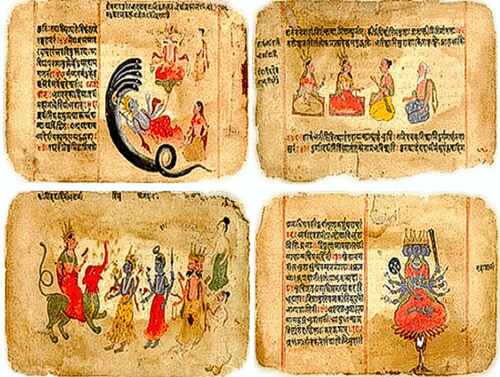
One distinction sharpens this. Vedic — in the strict philosophical sense — refers to traditions that accept Vedic textual authority. Many lineages named here do not: the Āgamas assert their own scriptural authority; the Śaiva Siddhānta positions itself as parallel revelation; Dravidian astrological schools operate from their own canonical frameworks. The claim is not that these traditions are Vedic in that doctrinal sense. The claim is that they share a cosmological substrate that precedes both Vedic and Āgamic doctrinal streams — nakṣatra astronomy, planetary cosmology, kāla as sacred architecture. This is the critical point: the Ṛgveda is not the source of this science. It is the earliest witness to it. The nakṣatras were being tracked before the first hymn was composed; the planets were moving through their cycles before the first ritual was codified. The Ṛgveda articulates this substrate in its oldest hymns; the Āgamas carry it through their own revelation structures. Neither owns it. Both transmit what was already there.
The Aryan Invasian Theory (AIT) emerged from nineteenth-century colonial philology, most prominently through Max Müller, positing that the Vedic tradition was brought by Indo-European migrants who invaded the subcontinent around 1500 BCE, displacing a darker-skinned indigenous population. The racial dimensions were explicit in the theory's originators. The construction served British colonial governance in two directions: externally, positioning the most sacred elements of Indian civilization as essentially European in origin; internally, providing the civilizational rupture narrative that divide-and-rule strategy required.
The connection to the Pingree transmission paradigm is structural, not coincidental. Both constructions emerged from the same period of colonial scholarship, both positioned Vedic culture as derivative and epistemically secondary, and both operated by minimizing indigenous achievement while amplifying every trace of possible foreign influence. The double displacement — colonial renaming from without, invasion narrative from within — was not accidental. It was the architecture of epistemic conquest.
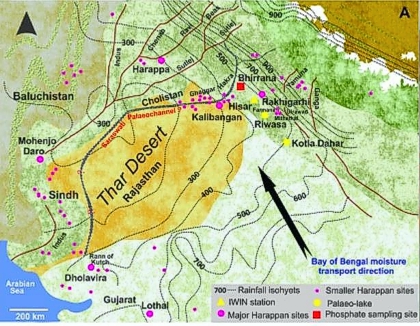
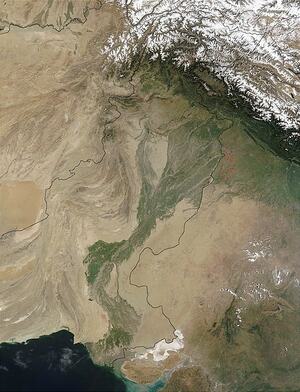
The AIT's foundational claim is no longer defensible. The Ghaggar-Hakra riverbed, confirmed by geological and satellite survey as a major river system that dried up around 1900 BCE, is the Sarasvatī of the Ṛgveda — hymns celebrating a living river therefore predate any 1500 BCE invasion scenario.[12] Vasant Shinde and colleagues' 2019 ancient DNA analysis of Rakhigarhi found no significant steppe pastoralist ancestry — the genetic signature hypothetical Aryan migrants were supposed to have left.[13] The invasion framing cannot survive its own evidence. The story of Vedic culture as a foreign import lacking indigenous roots can no longer be sustained.
The astronomical case cuts deeper than genetic or geological evidence alone. If the Vedas witnessed a pre-existing astronomical reality rather than introduced one, then no migration can have brought the science — the science predates any text, and therefore predates any people who might have carried a text. The invasion narrative requires the Vedic tradition to be a package that arrived from outside. The astronomical evidence shows it was already here.
The Sanskritization objection deserves a direct answer. Sanskritization, as M.N. Srinivas defined it, describes lower-caste communities adopting Brahminical ritual forms — sacred thread, Vedic recitation, Sanskrit liturgy — to claim social legitimacy. The Thirukkural, dated between the 1st century BCE and 5th century CE, shows none of these markers. Its celestial mechanics appear as native philosophical equipment argued on Tamil terms, in Tamil verse. Borrowed legitimacy adopts the forms of the dominant tradition. The Thirukkural develops its own. The Valluvar community's astrological lineage is not Sanskritization. It is parallel indigenous development within a shared cosmological world — the world the Vedas were first to articulate in text.
That world has a center of gravity: karma and kāla — consequential action and sacred time — operate on every being without exception, regardless of lineage, caste, or doctrinal affiliation. The Brahmin and the Dalit move through the same planetary periods. The same nakṣatra governs the same cycle for both. A science whose subject matter is universal cannot be the exclusive property of any social group. The Vedic designation names the civilizational tradition that first mapped that movement — and the map belongs to everyone who travels by it.
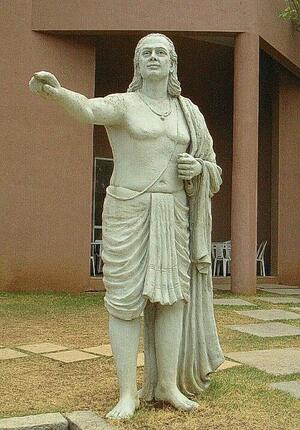
Reclaiming "Vedic" as a civilizational rather than caste category restores the term to the broader reality it has always described and refuses the colonial narrowing that obscured that reality for two centuries. Brahmins represent approximately three to four percent of the Indian population, yet practitioners of Jyotiṣa and its derivative folk traditions span nearly every community across the subcontinent, including Dalit and Shudra groups whose engagement with celestial mechanics has never required Brahminical authorization. That breadth is not incidental. It is what the Vedic designation has always named.
A legitimate genealogical objection deserves acknowledgment here. Before the 1980s, the practice was almost universally referred to in English as Hindu Astrology — the term used consistently by B.V. Raman and his contemporaries through the mid-twentieth century. The pivot to "Vedic" was a conscious decision made by a cohort of practitioners working in the San Francisco Bay Area in the late 1980s, among them James Braha, David Frawley, and Chakrapani Ullal. They found that "Hindu Astrology" carried ethnic and religious associations that sat uneasily within the secular-spiritual culture of the human potential movement; "Vedic" sounded more ancient, universal, and scientifically respectable. Frawley's subsequent writings — above all his 1990 Astrology of the Seers — carried the new term into the global market, where it took root alongside Ayurveda and Vedanta as part of a coherent "Vedic" brand. His documented associations with Hindu nationalist intellectual circles give critics additional grounds for scrutinizing that coinage, and the scrutiny is warranted.
It is not, however, sufficient to settle the question this paper asks. The civilizational argument advanced here does not depend on Frawley's branding. It depends on RV 1.164.48, on the Kṛttikā precessional dating, on Billard's demonstration of Āryabhaṭa's observational independence, and on the functional embeddedness of Jyotiṣa as the Eye of the Veda within the Vedāṅga corpus. That evidence predates the 1980s by several millennia. The English label is recent; the reality it points to is not.
The parallel is instructive. "Greek philosophy" retains full scholarly standing despite the fact that no ancient Greek used the term in English, and despite its appropriation by Western nationalist projects across two centuries. The standard, applied consistently, asks whether the civilizational reality a designation names is real — not whether the English label is old or whether contemporary politics has found it convenient. Jyotiṣa named itself the Eye of the Veda long before the Bay Area gave it a new English wardrobe.
VI. The Tradition Knows Its Own Name
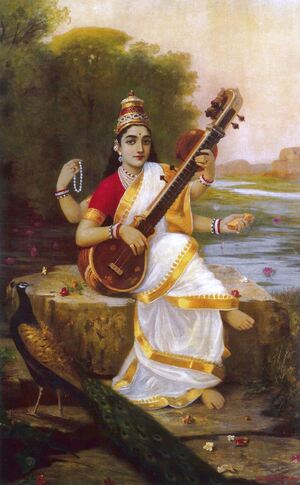
The tradition has always known its own name. The question is whether Western scholarship will accept that. Nomenclature is never neutral. The preference for "Indian astrology" over "Vedic astrology" is not a methodologically innocent choice. "India" is a four-stage colonial transformation of a Sanskrit river name. The transmission paradigm rests on documented fabrication. The Aryan Invasion Theory cannot survive its own evidence. The internal South Asian challenge, while historically grounded, accepts the colonial narrowing the tradition's own diversity refutes. The solution is not further erasure. It is restoration.
Jyotiṣa is Vedic astrology. The Ṛgveda itself records its origins — in the wheel of twelve fellies of the first book's 164th hymn, 48th verse; in the nakṣatra system's documented antiquity; in the Kṛttikā vernal equinox placing systematic lunar mansion observation in the third millennium BCE. Jyotiṣa reflects the Vedāṅga designation: functional rather than ceremonial, a discipline as structurally essential to the Vedic corpus as sight is to the body. It carries the philosophical substrate of karma, dharma, and rebirth that makes the Vedic time lord system intelligible. Without that framework, the timing system ceases to function. The science of light was not a foreign graft. It was a flowering of Vedic genius, emerging from the same civilization that composed the Ṛgvedic cosmic hymns, mapped the lunar calendar through the nakṣatra system, and encoded altar-geometry in the Śulba Sūtras.
The designation requires no apology. Jyotiṣa practitioners cast charts by the sidereal zodiac, interpret through lunar mansion and planetary period, prescribe remediation from Vedic and Tantric sources, and work within the soteriological framework of karma and dharma. The practice names itself by what it is: Vedic astrology. Let Western scholars rename it if they will. The tradition knows its own name. Jyotiṣa — the science of light, the Eye of the Veda, the guide of the soul through the eternal rhythms of sky and time — was Vedic before Darius named his Persian province, Vedic before Alexander's geographers coined their Indos, and Vedic long after those administrative categories dissolved into the dust of colonial memory.
William R. Morris, PhD, DAOM, RH
William is a medical astrologer who gave his first consultation in 1977. He is practicing in the Kootenay Lake District of British Columbia. His background includes a master's degree in medical education from the University of Southern California, a clinical Doctorate and Acupuncture and Oriental Medicine, and a PhD in transformative inquiry focused on practice-based knowing. Will has published books on TCM and astrology and has 43 years of clinical experience using astrology as a feature of practice. During the 1990s he focused his practice on the methods of Lilly and Culpeper with 40 patients a week. He also used sidereal, cosmobiology, and Jyotish methods during that period. His work is a creole blend of music, astrology, medicine, and magic.
References
[1] The etymology of Sindhu through Persian, Greek, and Latin transformations is standard comparative linguistics. For the historical and geographical context, see Moriz Winternitz, A History of Indian Literature, vol. 1, trans. S. Ketkar (Calcutta: University of Calcutta, 1927).
[2] The Ṛgvedic Nadī Stuti (RV 10.75) addresses the rivers by name in geographical sequence. No hymn addresses a river called India or Bhārata in any form approximating a national or cultural self-designation.
[3] The terms sacred revelation and sacred memory are foundational to Mīmāṃsā epistemology and govern how Jyotiṣa's authority is understood within the Vedic corpus; see P.V. Kane, History of Dharmaśāstra, vol. 1 (Poona: Bhandarkar Oriental Research Institute, 1930), 3–10.
[4] RV 1.164.48: dvādaśa pradhayaś cakram ekaṃ trīṇi nabhyāni — "twelve are its fellies, the wheel is one, it has three naves." The twelve fellies correspond to twelve solar divisions; the single wheel is the annual solar circuit; the three naves are the three seasons of the Vedic year. The 360 spokes map to the degrees of the solar year.
[5] Klaus Schmidt, Sie bauten die ersten Tempel: Das rätselhafte Heiligtum der Steinzeitjäger (Munich: C.H. Beck, 2006). On stellar orientations at Göbekli Tepe, see Giulio Magli, 'Sirius and the Project of the Megalithic Enclosures at Göbekli Tepe,' Nexus Network Journal 18, no. 2 (2016): 337–346.
[6] J. McKim Malville et al., 'Megaliths and Neolithic Astronomy in Southern Egypt,' Nature 392 (1998): 488–491. For broader archaeoastronomical context, see S. Balachandra Rao and S.K. Uma, 'Archaeo-astronomy in Indian Context,' Bulletin of the Astronomical Society of India 34 (2006): 1–21
[7] The Kṛttikā dating relies on Śatapatha Brāhmaṇa 2.1.2.3, which records the Kṛttikās as never deviating from the east — an astronomical statement consistent with a vernal equinox position for that nakṣatra, calculable via precession to approximately 2950 BCE. See Subhash Kak, 'The Astronomical Code of the Ṛgveda,' Current Science 66, no. 4 (1994): 323–326. For the precessional calculation methodology, see George Thibaut and Sudhakar Dvivedi, eds., The Pañcasiddhāntikā of Varāhamihira (Benares: E.J. Lazarus, 1889; repr. Varanasi: Chowkhamba Sanskrit Series, 1968). See also Bartel Leendert van der Waerden, 'The Great Year in Greek, Persian and Hindu Astronomy,' Archive for History of Exact Sciences 18, no. 4 (1978): 359–384.
[8] Bill M. Mak, 'The Date and Nature of Sphujidhvaja's Yavanajātaka Reconsidered in the Light of Some Newly Discovered Materials,' History of Science in South Asia 1 (2013): 1–20; Mak, 'The Transmission of Greek Astral Science into India Reconsidered,' History of Science in South Asia 2 (2014): 1–29.
[9] Kripa Shankar Shukla, 'The Yavanajātaka of Sphujidhvaja,' Gaṇita Bhāratī 11, nos. 1–4 (1989): 25–30.
[10] Roger Billard, L'Astronomie indienne: Investigation des textes sanskrits et des données numériques (Paris: École française d'Extrême-Orient, 1971). Billard's deviation-curve method showed that Āryabhaṭa's mean planetary parameters converge statistically on 510 CE, consistent with independent contemporary observation rather than transmission of Greek values.
[11] On Tamil Jyotiṣa lineages and non-Brahminical astrological traditions, see K. Chandra Hari, 'Origin of Horoscopic Astrology in India,' Indian Journal of History of Science 38, no. 3 (2003): 221–245.
[12] The Ghaggar-Hakra identification with the Sarasvatī of the Ṛgveda is supported by geological and satellite survey of a dried riverbed consistent with a major watercourse active during the Harappan period. See K.S. Valdiya, Saraswati: The River that Disappeared (Hyderabad: Universities Press, 2002).
[13] Vasant Shinde et al., 'An Ancient Harappan Genome Lacks Ancestry from Steppe Pastoralists or Iranian Farmers,' Cell 179, no. 3 (2019): 729–735. See also David Reich, Who We Are and How We Got Here: Ancient DNA and the New Science of the Human Past (New York: Pantheon Books, 2018).
Sources
Billard, Roger. L'Astronomie indienne: Investigation des textes sanskrits et des données numériques. Paris: École française d'Extrême-Orient, 1971.
Chandra Hari, K. 'Origin of Horoscopic Astrology in India.' Indian Journal of History of Science 38, no. 3 (2003): 221–245.
Kak, Subhash. 'The Astronomical Code of the Ṛgveda.' Current Science 66, no. 4 (1994): 323–326.
Kane, P.V. History of Dharmaśāstra. Vol. 1. Poona: Bhandarkar Oriental Research Institute, 1930.
Mak, Bill M. 'The Date and Nature of Sphujidhvaja's Yavanajātaka Reconsidered in the Light of Some Newly Discovered Materials.' History of Science in South Asia 1 (2013): 1–20.
Mak, Bill M. 'The Transmission of Greek Astral Science into India Reconsidered.' History of Science in South Asia 2 (2014): 1–29.
Magli, Giulio. 'Sirius and the Project of the Megalithic Enclosures at Göbekli Tepe.' Nexus Network Journal 18, no. 2 (2016): 337–346.
Malville, J. McKim, et al. 'Megaliths and Neolithic Astronomy in Southern Egypt.' Nature 392 (1998): 488–491.
Pingree, David. The Yavanajātaka of Sphujidhvaja. 2 vols. Cambridge, MA: Harvard University Press, 1978.
Rao, S. Balachandra, and S.K. Uma. 'Archaeo-astronomy in Indian Context.' Bulletin of the Astronomical Society of India 34 (2006): 1–21.
Reich, David. Who We Are and How We Got Here: Ancient DNA and the New Science of the Human Past. New York: Pantheon Books, 2018.
Schmidt, Klaus. Sie bauten die ersten Tempel: Das rätselhafte Heiligtum der Steinzeitjäger. Munich: C.H. Beck, 2006.
Shinde, Vasant, et al. 'An Ancient Harappan Genome Lacks Ancestry from Steppe Pastoralists or Iranian Farmers.' Cell 179, no. 3 (2019): 729–735.
Shukla, Kripa Shankar. 'The Yavanajātaka of Sphujidhvaja.' Gaṇita Bhāratī 11, nos. 1–4 (1989): 25–30.
Thibaut, George, and Sudhakar Dvivedi, eds. The Pañcasiddhāntikā of Varāhamihira. Benares: E.J. Lazarus, 1889; repr. Varanasi: Chowkhamba Sanskrit Series, 1968.
Valdiya, K.S. Saraswati: The River that Disappeared. Hyderabad: Universities Press, 2002.
van der Waerden, Bartel Leendert. 'The Great Year in Greek, Persian and Hindu Astronomy.' Archive for History of Exact Sciences 18, no. 4 (1978): 359–384.
Winternitz, Moriz. A History of Indian Literature. Vol. 1. Translated by S. Ketkar. Calcutta: University of Calcutta, 1927.